Archiv der Kategorie: Fragmente

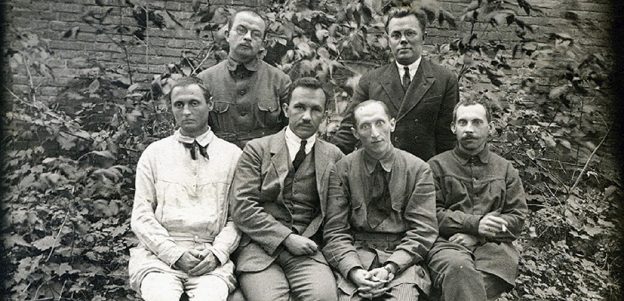
Schwarz-Weiß-Pho­to­gra­phie

Fernab von zähen Warteschlangen und zynischen Festzügen, im gelben Gestank der Belomorkanal-Schwaden, hinter der Sperrholzbarrikaden der Parteibüromöblierung, unter der papiernen Aufsicht der von den Wänden wachenden Parteititanen ersannen die Wirtschaftsphantasten und Fünfjahresplan-Mystiker Gehälter, die Kwasverkäufer und Klavierlehrerinnen durch »Haltura« – die Schwarzarbeit der Schattenwirtschaft in der Sowjetära, – gezwungen waren aufzustocken. 

Während die Fabel vom Fortschrittsgalopp zu bleiernen Prawda-Schlagzeilen erstarrte, blieb die Farbfotografie hinter der Eisernen Vorhang bis zum Ende der 1970er Jahre eine Seltenheit, wenn nicht sogar eine bösartige Fiktion der kapitalistischen Propaganda – obwohl sie seit Ende der 1950er Jahre in den Taschen fast aller westlichen Verbraucher zum Schnappschuss griffbereit war.

Der Trost eines zaghaften Erzähl- und Selbsttäuschungswillens drückte sich in den zarten Farben des Nachkolorierens aus. Unter dem Vorwand und dem Schutz der Nostalgie durfte ganz nach eigenem Belieben nachkoloriert werden – der Kwasverkäufer schrieb die entfärbte Vergangenheit selbst um. Die dünnbeinigen Holzstaffeleien stellten sie in ihren Küchen auf den bereits verschlissenen PVC-Böden der Chruschtschowkas, den Betonödnissen an den Stadträndern.

Die Massenlandflucht, eine Folge von Stalins Zwangskollektivierung und Industrialisierungseifer, offenbarte einen Wohnraummangel, der sich in programmatischen Mobilitätsrestriktionen und atemloser Zersiedelungshektik entlud. An den zerzausten Stadträndern wuchs eine vertraute Skyline aus Turmdrehkränen, Sandhaufen, verlassenen Laderaupen und Mastleuchten. Die aufgepeitschte Bauwut schlug in Baufrust um und mündete letztlich – aufgrund des ubiquitären Defizits und der Planungsunordnung – in Bauennui. Die Skyline verflachte durch Erosion und Plünderung. Die vorstädtischen Narbenlandschaften erlahmten im Werden, Warten und Erwarten der 60er und 70er Jahre.

Trotz der Gruben für die Betonsockel der baldigen Leninstatuen oder der Sicheln-und-Hämmer-schwingenden Kolchose-Kolossen, trotz abgezirkelter Grünflächen und Spielplätze auf Plänen, die sorgsam gefaltet in den Schubladen der Parteistädteplaner vergilbten, trotz Holzpfosten, die Trolleybus-Haltestellen ankündigten, trotz Blitzableitern auf den Dächern und Lichtern in den Fenstern, lagen die besiedelten Neubausiedlungen brach.

An Samstagen, nach dem gefügigen Makulatursammeln fürs Vaterland, scheuerten die Kwasverkäufer mit Pastellkreidestaub die Familienfotos bunt, weder schöpferisch ambitioniert noch von Kundenwünschen getrieben. Stumpfsinnig rieben und schmierten sie für ihre Abnehmer, die ihrerseits weder Ansprüche stellten noch ein Recht auf Mängelrügen besaßen. Als dann anschließend die verbrauchten Rubel die Hände wechselten, stieß man vielleicht mit Horilka an, um wort- und freudlos das Business zu begießen und ohne Händedruck davon zu eilen.

In der rot-schwarzen-Tyrannei der Parteilosungen war der dünne Farbschleier des Nachkolorierens eine gehauchte Klage, ein wortloses Sichtbarmachen der Last des Stummheit, ein zwanghaftes Räuspern im Schweigediktat, der Seufzer nach Sorglosigkeit. Die bis in die späten Siebzigerjahre hinein noch üblichen Graustufenfotos gaben eine schmucklose Realität wieder, die sich zu einem bloßen Versprechen von Farbe in einer fernen Zukunft hinausdehnten – einer trotz allem unvermeidlichen Zukunft, in der Farbe überflüssig, verboten oder gerecht verteilt sein wird wie Hackfleisch oder Urlaubstage. 

In den monochromen Fotos drängten sich heimatlose Muster, Strukturen und Texturen in den Sichtfeld. Das Auge suchte in ihnen die Monotonie des Vertrauten, den Fluchtpunkt brutalisierter Homogenität, um sich in ein passives Hinsehen zu verlieren: »Ich erkenne nicht – ich fühle nichts.« 

Ich erkenne nicht 

Das manipulierte Motiv, durch das anfängliche Entfärben und nachträgliches Kolorieren, unkenntlich gemacht, verunsicherte das Auge, und mit ihm mühte sich das Gehirn ab, den Widerspruch zwischen dem Gesehenen und der Erinnerung, die aufbegehrte, sich widersetzte, die Echtheit der Aufnahme anzuerkennen, zu versöhnen.

Ich fühle nichts 

Das vom Kwasverkäufer beliebig nachkolorierte Foto – ein bloßer Pappdeckel, rahmenlos, mit Glanzkunststofffolie überzogen und mit ausklappbarem Pappstandfuß – wurde neben dem Teeservice und der leeren Cognacflasche aus Tbilissi in die Vitrine gestellt und verstaubte zu einer historischen Requisite. Eingereiht in die Parade authentischer Erinnerungsstücke und greifbarer Andenken, Fetzen von tatsächlich Geschehenem, vergilbten nachkolorierten Bildnisse ins Authentische, Staub und Patina belegten ihre Echtheit. Nach und nach gewöhnte sich das Auge daran, brachte das Entfernte an das zuverlässig Signifikante näher. Der Zweifel legte sich, die Erinnerung schwieg und gab die nacherzählerische Hoheit an das kolorierte Schwarz-Weiß-Bild ab. Die eintretende Derealisation war sowohl zweckmäßig als auch endgültig und in der sich ein „War das so?” unmerklich zu einem „So war es” entfremdete.
to a friend

Take 1

The cake is sweet and frosted ’round the edges,
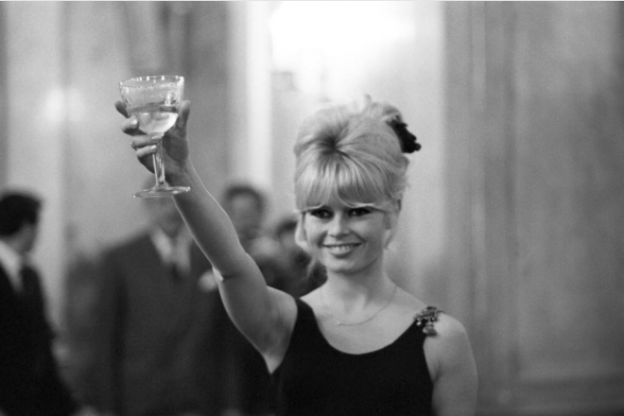
Arms are aloft with glasses poised to toast,
The round of giddy wishers - cheering, grinning -, 
With hands outstretched for candied wedges.

Some wish you health, yet others nimble limbs
To dance a jig or prance about for ages;
Still others, glad of your success forthwith,
Praise you - »the author of the feast« -  with hymns.

Yet as all joyous roars subside, 
And woozy well-wishers into the darkness flee,
A steady flame of friendship still remains 
And is the best hope and the truest guide.


Take 2

Behold the cake, with sugared borders graced,
Round which the crowd in cheerful circle haste;
With lifted glass they consecrate the hour,
And hail the moment with their vocal power.

Some wish thee health, and some a nimble frame,
To sport with time, and mock decrepit shame;
While others, charmed with Fortune’s partial smile,
Extol thy triumphs in a tuneful style.

But when the shouts of mirth are heard no more,
And Bacchus’ vot’ries reel from out the door,
One faithful flame, secure from fortune’s tide,
Shines still—true Friendship, Hope’s unerring guide.

Take 3

Sweet centerpiece, complete with dedication 
And bound with frosted filigree, 
The giddy guests with bubbly libation
Salute your yearly jubilee.

The wish, ne’er absent nor politely slighted,
That fortune may forthwith upon another frown,
No praises of successes past unsung 
Nor prayers for wealth to come are uninvited.

The hopes for health of body – oft reprised –
Are neither left unhoped nor wearily unheard.
And ‘midst the merry murmur for the final want
That of your peace of mind, is shortly ill-advised.

Take 4

Fair table’s pride, with sugared pomp array’d,
And bound in frost of cunning carver’s hand,
The mirthful train with sparkling draughts o’erweigh’d
Proclaim thy natal hour through all the land.

No wish is lacking, none with silence shunn’d,
That Fortune’s fickle brow may frown elsewhere;
No tale of former triumph left unsung,
Nor prayer for golden plenty banish’d there.

The hope of health, so oft renew’d by breath,
Is neither wearied out nor left unspoke;
And midst the merry hum, one counsel yet—
That peace of mind be thine—is rashly broke.

For joy, not sober care, doth crown this night,
And banquets live by laughter, not by plight.

September 27 2025

Bild © AP

Von der Unfähigkeit, einfache Sätze zu schreiben

»…Es war uns wichtig zu vermitteln, dass die zentralen Themen seiner schriftstellerischen Arbeit nicht in der verflachten gesellschaftspolitischen Dimension zu finden sind, sondern im Ausdruck des Überzeitlichen durch die Nahaufnahmen alltäglicher seelischer Grenzsituationen – die philosophisch-existenzielle Auseinandersetzung mit menschlichem Leid aus tiefster Anteilnahme.«1

a.m. 6.8.92 voices from the past

Pretentious philosophs. They bear the unsubstantiated idea, out of premature pseudo-analysis, that an I is a solipsistic impulse. That I, frequently, disregard the councel of rationale, skirt self-reflection. Not so. Perhaps partially correct. But the decision to act on impulse and intuition does not suggest lack of reasoning potential or lack of reasoning (cogitare). Neither is a decision to act on impulse a contradiction in terms. For the self-aware it is a conscious choice. (Of course one may argue whether opting for intuition – a conscious decision to go with the gut-feeling – is an absurd concept in itself, as any preceding deliberation negates impulsivity; that impulse is a fairy-land beyond reason, where reason dare not dwell or enter.)

Friendship. An encumbering self-reenactment, escape. It is into them – our friends – we drain our sewage, (dump the debris) of (noxious sentiments) and doubts we cannot (otherwise) cleanse ourselves of. It is a sad metaphore. In general that is what occurs. As it is a rare phenomenon, a fluke, when friendship is a mutual enrichment; usually, it is a theft and friends are thieves. Thieves who ransack and pillage one’s emotions, take advantage of the gullible benignity, (selflessness) – the likeness, the optimistic faith of and in humanity as the last and only resort. I speak of abusive, insatiable taking, the theft, an albeit amiable, (sanctioned) theft.

And the true friendship, platonic and heterosexual, must then be a deliberate effort for mutual benefit, a transactional equilibrium, sensitive and intuitive, entailing an insight and respect for boundaries and an acute awareness of tact and acceptance. Acceptance and trust in kind judgement of the other’s potential for expedience or utility.

8:23 8 11 23

For posterity, wripped into neat squares. But maybe, thousand years from now, a little piece will endure the rot and find its way into the hands of an archeologist, who will attempt to decipher the neurotic script, the disarray of thoughts and try to find meaning, where there is none.

dear reader of the future, study not these scribblings – i am merely cleaning the drive – making room for new, for better thoughts. And everywhere now, in this our age of intellectual significance, when nothing is banal and everthing is cherished, there is so much. i sometimes feel, in my head there is no fillable real-estate left – everthing is peopled with throw-away information and like a hoarder, I tremble compulsively when forced to dismiss, discard and disown, judge or discriminate between what to chuck and what to cherish. Like Saunders, who, i am certain, is rigorous. his rigor albeit concerns the written and not the thought. is any conjured path wrong? can it be judged? or is the pattern created lost or works not on the level of detail but as a net – there is no pattern, only the function of the holding everthing together, the sound structure, not the individual units.

My mind wanders off. patience has evaporated or has been trimmed away. time is the tyrant who commands and rules solitary. the straight arrow to the bull’s eye of result. there is no bench to sit upon and rest and play, and feed the pigeons – every thought is scrutinized according to its function, its utility. and if deemed useless, i do chuck it. well, maybe not thoughts, but definitely dust collectors like people. they squat on the prime real-estate of time. time, of which there is plenty and which lies desolate and unpopulated, as it were.

but is time not mine to do with as i like? just as thoughts? it is my slave and serves me. no other shall have it lest i give it freely. but.

and language is there to be used and it lives and dies. pehaps dictionaries, like museums, similarly hoard species long extinct. very much so. but astounding relics of the past nevertheless mirror back to us images of our ancestors, as our extinct word-species will, at some point, have a needle in them, powdery, mummified, speciments that future generations will study with the desire to understand, reconstruct, but will never. because in the little note near the word-specimen they will read – „used during…“, or „from the epoch of…“. and they will never understand, because its use has become obsolete, in all the manifold ways obsolence occurs.

And is there, or am i such a child, an old child of modernity, who is useless, is dust at best? can one reconstruct a picture out of dust, a substance that will explain or help explain? Sure, nothing is useless – perhaps is useless dust not at all useless – perhaps it is filling up a space that would otherwise have been a vaccuum and then there would be a conjecture and a question mark at best. but the dust points to something – saying or embodying a sign, a hint – there was! there was something. a proof of not nothing. there was someone who – someone who thought something – someone who said something. and this dust is your parent or ancestor of those future thoughts.

time features promenently now. why? before, even a couple of years before, i need not stray too far back, not one thought of time, no awareness of its existence. what time means now–then it was whim – the egocentric whim that reigned over all. not when, but want. to whim i knelt before. now – a humble subject of time.

cleaning the dust collected on the thought-shelves, stacks of thoughts in the corners, piled one upon another, with a thin layer of emotion between them, like rice paper or wax paper, browned and leathery what once was seemingly, poignantly alive, so prickly and ardent. the mental lists make me weary and it doesn’t help to bring them to paper. when i cast my eyes on the rows of musts, exhaustion ensues, the sand kernel by sand kernel growing mountain of musts, overwhelming and humbling me, having not yet ventured on the uphill journey.

is the child dying into an adult? the child who just is, just does, just wants now, who cares not for utility, who has no direction, like time, it lives in one and all the dimensions of the eleven-dimensional world of its own capricious design, or on the plane of designlessness – just the will to see, to be curious, the will just…

from here

from here
we cannot see the harbor,
where a vendor – hoarse and reeking,
sings,
and whores – gray and foreign
drift, 
gossiping of fishy things,
along the creaking gangplank.

bottles bob, barrels roll
miles of mesh lie limp and waste
windless years –
on the creaking gangplank. 

in this vast paradise – 
horizonless and edgeless –
we are bunched up 
in the middle of our dinghy.
i raise my hand above your head 
at midday.

Like father…

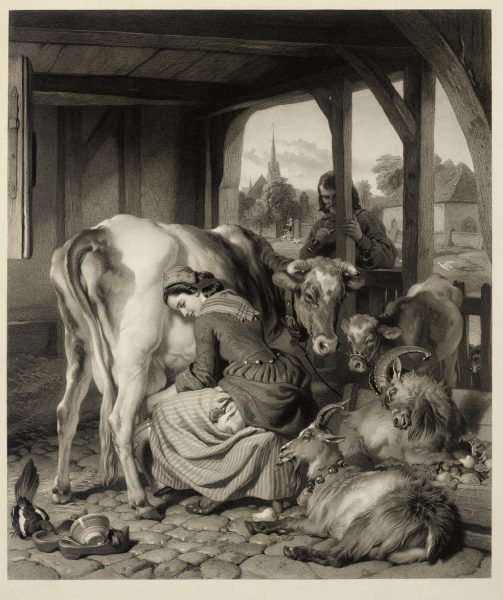
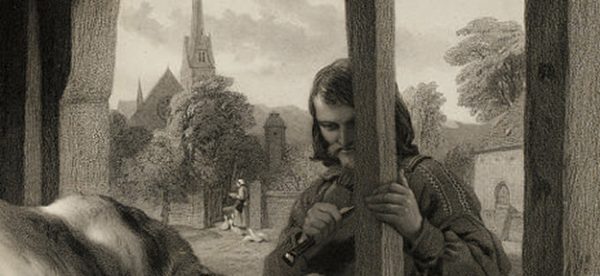
In his whimsical autobiography, H.G. Wells – detailing his family’s history – claims that his father, while in service as a gardener, stood model for the sneaking youth in the painting The Maid and the Magpie by Sir Edwin Landseer.

„…a frequent visitor at Redleaf was Sir Edwin Landseer, the „animal painter,“ …who did those grave impassive lions at the base of the Nelson monument in Trafalgar Square. My father served as artist’s model on several occasions, and for many years he was to be seen in the National Gallery,… But afterwards the Landseers were all sent to the Tate Gallery at Millbank and there a sudden flood damaged or destroyed most of them and washed away that record of my father altogether.

this here

will the momentum of puberty’s paroxysms suffice to persist in the investigation? and truth and wisdom – arbitrary, spacious, elusive and implacable? is there consolation? how to endure the tears from the stinging light, the tears of epiphany…the bliss of grasping, even for a moment, a meaning, or an idea, but not consciously, but with the soul and mind and senses.

truth demanded many lives, of men worthier than i. and with my social suicide I join them, if only thus – still meek and doubting, fearful and selfish, still glancing back nostalgically, at the other life – so snug, so peaceful. and so false.

that there

mystery. magic. puzzles – riddles. secrets. arcane or prosaic. like the horizon: blue-sky, taunting and intimidating. the unknown. the unknowable, yet explained and evident. although I understand, I nonetheless acknowledge its deceitful existence – there it is, I see it and how, then, I ask increduously, can it be a concept, just an idea and not a thing – this, that I see. imperceptibly moving forward, like time – it too, just a figment.

or love. like horizon’s edge, endlessly stretched (like giacometti’s limb) between me and that life, the mirage is measured into existence, as a formula, or seized by a stanza: there – you point at it – there, can you not see it? can you not believe in it? and then, reason, with a slightly raised eyebrow, strokes my childish head with its pitiless palm and says: no, dear child, it is only an illusion.